muteval
Mutation testing for your LLM evals — find out if they'd actually catch a regression.
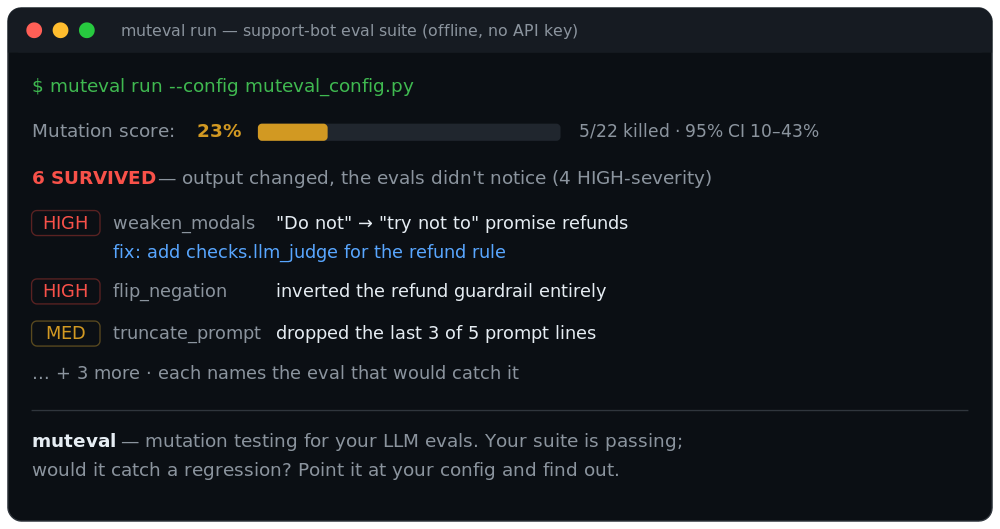
Your evals are passing. That doesn't mean they work. muteval deliberately degrades the system under test (the prompt, retrieved context, tool outputs, or model), reruns your existing eval suite against each degraded version (a "mutant"), and reports a mutation score — the percentage of injected regressions your evals caught. The ones they miss are survivors: candidate coverage gaps for you to triage.
It's mutmut / Stryker, but for evals.
See it run on a promptfoo suite → Example{ .md-button .md-button--primary } Read the limits{ .md-button }
Install
60-second quickstart (no API key)
muteval init --template rag                  # scaffold a config
muteval check --config muteval_config.py     # validate wiring + baseline first
muteval run   --config muteval_config.py     # score + ranked survivors + suggested fixes
New here? The 5-minute tutorial walks the whole loop with the output explained.
What it is — and isn't
muteval is a per-suite diagnostic. What that means:
- A survivor is a candidate gap — flagged for review, not an automatic verdict on your system.
- It measures eval coverage (would the suite notice a regression?), not whether an eval is correct — that needs labels.
- It fails closed: a red or errored baseline yields no score, never a misleading 100%.
For the full picture, read the Limitations and the Findings for what's been measured.
Where to go next
- Example — a promptfoo suite — install, point it at a config, read the two reports.
- Adopting muteval — a ~1-hour integration guide for your own suite.
- Findings — does the mutation score actually track eval quality? (Yes, across four domains, CI-enforced.)
- Plugins — extend with your own operators, probes, adapters, and reporters.
- Prior art — how this relates to mutation testing and meta-evaluation research.